My AI Handbook: Should You Use AI For That?
My take on how to have good boundaries with AI.
April 7, 2025
When I first started studying Artificial Intelligence, I saw it with fresh eyes. For me, it was an exciting and intellectually stimulating line of research, and it had much promise for helping the world in myriad ways. But unfortunately, my mind quickly changed in those early years, and my pessimism has only grown since.
In the early days of artificial intelligence, much of the progress was in discriminative networks (I don't mean the early days like the 20th century, I mean the early days of modern GPU-backed neural models). And I still think this is the best use-case for AI: parsing huge amounts of data and performing retrieval or function approximations. There is minimal harm (perhaps just enabling mass surveillance or incentivizing unrestricted data collection), but a lot of benefits like cancer detection, better web searches, easier learning, better information dissemination, better climate modeling, better disaster planning, etc..
A lot of the problems came when we started focussing on generative AI. Again, when I first started learning about GenAI, I was fascinated learning about autoregressive models, variational methods, energy based models, GANs, etc.–these all required complex calculus and had vast amounts of emerging research. But these were interesting intellectual problems just as I'm sure the manhattan project was equally enticing.
The difference between generative models and discriminative models mathematically is quite subtle. Whereas discriminative models are only able to predict P(y|x), generative models predict the entire joint distribution P(y). If we had infinite time and compute, making a generative model would be easy: just integrate any model that approximates P(y|x) over the entire input distribution and call it a day. But since we don't have infinite time or compute, we have to have more clever ways of constraining our models to be able to model the entire joint distribution. For example, autoregressive models achieve this by using the chain rule, energy based models do this by making the total energy easy to calculate, variational methods do this by approximating the ELBO instead of the true joint likelihood, and GANs do this by actually skipping computing the likelihood and just using a discriminator to judge the outputs.
My point is, the distinction between generative models and discriminative models is more subtle that it may seem. One interpretation of a modern day autoregressive language model is that it's just a discriminative model predicting the next token on a growing prefix of the total text. I believe that a model being generative or discriminative is much more an artifact of how the user uses the model than it is an inherent fact of the technology itself. For example, using an LLM generatively would look like asking it to write an email for you, whereas using an LLM discriminatively would look more like asking it to give you places to start learning more about plant ecology. In the first case, it is doing the work for you, while in the latter case, it is being used as a research tool–a search engine. While it can be argued that in both cases, the model "created" the output, the output that it is creating is fundamentally different. In the email case, it is doing the work of creating a new entity, while in the research case, it is fundamentally doing the work of understanding what your query was supposed to mean (something that your language alone wouldn't suffice in capturing) and finding related topics, all of this within the constraints of a generative model.
Should you use AI for that?
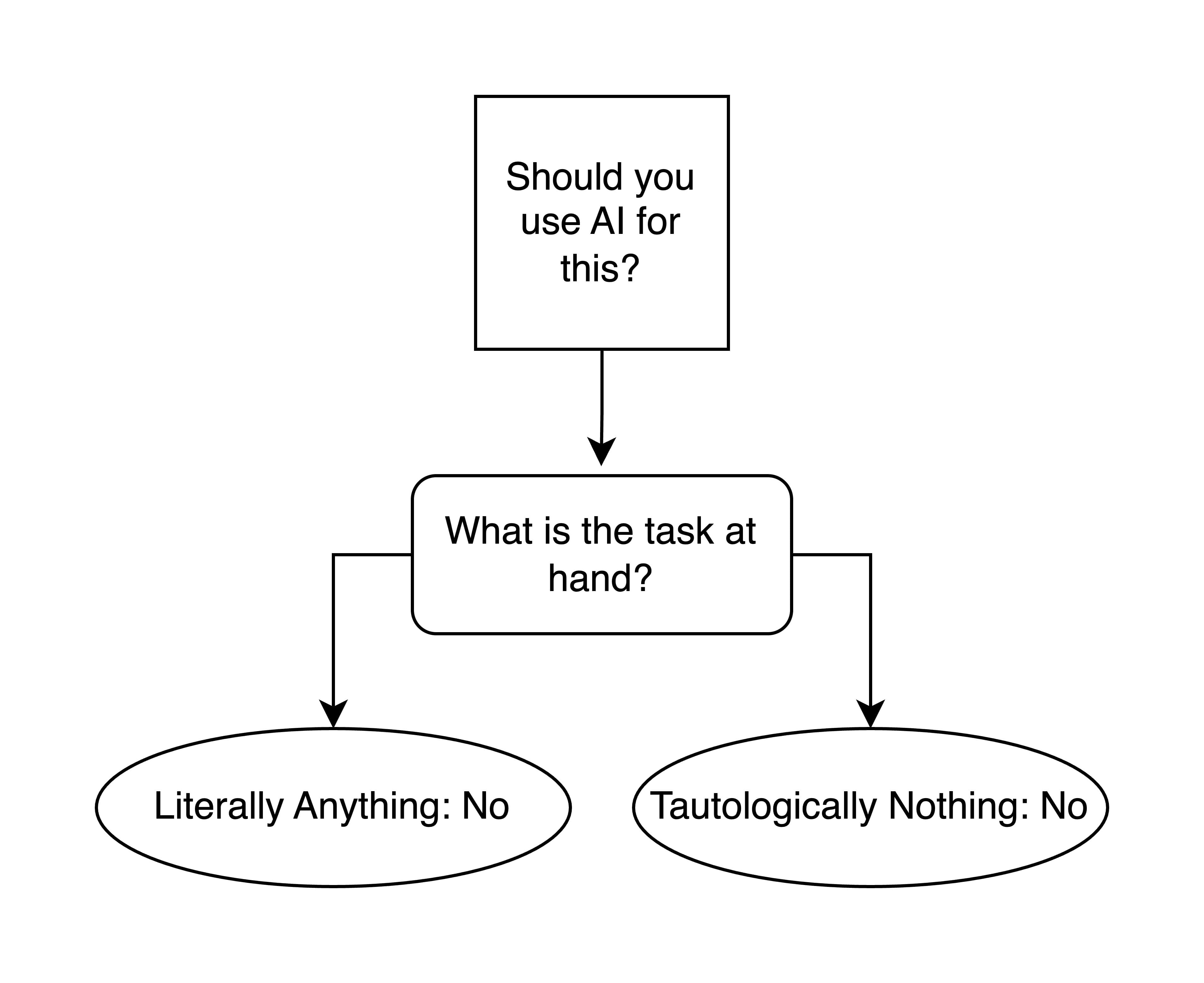
This brings me back to the central question of this post, which is what does it mean to use AI in a way that is not damaging to ourselves or others. While I do wish that the current state of AI was reverted a few years, I am mostly joking in the thumbnail of this post that we ought to never use AI for anything; however, I do think using AI responsibly is paramount for maintaining our sense of autonomy, curiosity, and humanity.
I argue that we ought to try to use AI in as much of a discriminative way as possible (please don't cancel me, I mean this is in the purely mathematical sense). Using it in this way maximizes the upsides while minimizing the downsides. The biggest upside of AI is its ability to understand vast amounts of data, so it should be used as that: an oracle for point us toward what we actually want to know. In this sense, it is more or less a fuzzy search engine that has a pretty smart fuzzy algorithm. Importantly, you should always try to use it to take you to the source, instead of believing it right its mouth. Yes, there is the problem that models are fine-tuned to respond confidently, even when they don't know what they're talking about, but there is the larger problem that LLM's are already controlled predominantly by technofeudalists and those with the capital required to train the models. So it's important to exercise skepticism when engaging with models. Even open source models are too complex to understand what they are trained on. So using a model discriminatively allows us the benefit of utilizing AI's immense understanding humanity's corpus of knowledge, without treading into the morally and spiritually questionable quicksand of generative modeling.
Which is what? My biggest problem with generative modeling is that it cheapens the act of creation. Humans are and should be creating each and every day, and yet access to powerful generative models makes this obsolete–that is, if you believe in creation only for the purpose of output. But no, creation is not for the purpose of what is being created, it is for what it stirs inside the creator. It is the sculptor himself who is truly carved by his hammer and chisel. Creation should be hard; that's what gives us resilience, confidence, courage, and a sense of community. The main arguments for why we keep developing these more powerful generative models for text, image, video, and audio is that it makes these things easier. Why do we want everything to be so easy, for corporate efficiency and profit? What a terrible prize for sacrificing everything it means to experience being a human. Generating outputs for yourself is cheap calories, but what truly sustains our souls is the rich fiber of putting effort into something. I'd rather make 10 times less if it means I made it myself; but this is bleeding into my other hot takes that we should stop trying to have such big impacts. In sum, AI destroys the important fabric of our culture of creation by cheapening both the role of artist and the art enjoyer. Taking effort to make something is what makes that thing worth making, and the knowledge that it took effort is what makes it worth enjoying. What happens when you lose that reciprocation, that trust?
So while I think text models can be useful if used correctly, I can hardly see a positive use case for image, video, or audio generation. And while I am too small to turn the tides of the pursuit of these powerful yet entirely unhelpful and frankly counterproductive technologies, I can make a sanctuary out of my own mind by using artificial intelligence thoughtfully. I use AI for work, but anything I truly care about, I will not let it touch it; that's for me to do.
I think the public sentiment will change around this anyway. As I've written in other essays, I think people will become so fed up with the grayish "perfection" of AI slop that they will learn to love imperfection. I hope this day will come soon.
While using AI discriminately is a pretty beneficial rule in most cases, it obviously doesn't deal with the minutia of every possible way there is to craft a prompt; and as far as I'm concerned, if there is a way for something to be abused, someone will do it. Here are some more broken down rules that target more specific cases:
Does it require thinking?
If so, do it yourself.
Is this a crime against humanity?
If so, do it yourself (well just don't do it at all please).
Is this something that really needs to be optimized?
Most of the time the answer to this is no. Most of the time, a worse result that takes more time will do, and it will be so much better for the health of your soul.
Is someone's job to do this?
Yes, there are some jobs that might be better off if replaced by AI (if they are dangerous or need better precision), most of the time, by using AI to do something that someone else would have done for you in the past just means theyir soul got captured by a tech conglomerate and you're talking to their ghost: a cheap approximation of the real person that in no way celebrates or supports the original person.
I'll be updating this list as I see more and more heinous ways people use AI.